
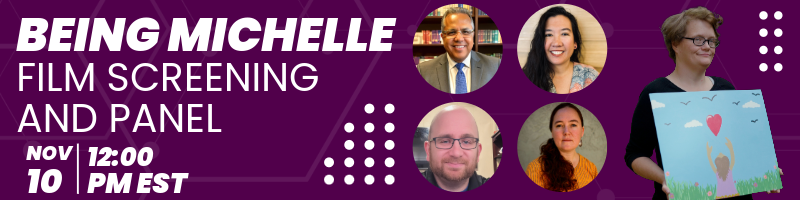
Image of event flyer, showcasing the four panelists.
Being Michelle Film Screening and Panel
Tuesday, November 10, 2026
12:00 p.m. – 3:30 p.m. EST
Join us for a virtual screening and interactive panel discussion of Being Michelle, an award-winning feature-length documentary film that reflects many of the barriers facing Deaf individuals across the country. Being Michelle is about a deaf woman with autism who survived incarceration and abuse and now uses her artwork to depict the trauma she survived and heal from her past. This film showcases the discrimination and barriers faced by Deaf and multiply disabled individuals in the current foster care and justice system. It also demonstrates how important community living and supports are to ensure safety and equality for people with disabilities.
During our interactive panel session, you’ll learn:
- What specific communication and legal barriers Deaf and autistic individuals face.
- How to work together with different experts and advocates to combat these barriers.
- How you can change public opinion on disability issues with the help of storytellers, creatives, advocates, and experts.
Can’t make the full event? Do not fret! You will have the option to the view the film at your own time one week prior to the event and then can join us for the panel at 1:45 p.m. EST on November 10th.
 Producer, Being Michelle. Executive Director & Co-founder, Thriving Roots Initiative.
Mae Thornton Mehra has been producing social justice and impact driven films with her husband and filmmaker, Atin Mehra at Orange Kite Productions for over 15 years. She prides herself on openly creative collaborations between film participants and diverse production teams as she believes that impact begins within the filmmaking process itself. In 2020, Mae and Atin co-founded the nonprofit Thriving Roots Initiative to further their work of social impact documentary filmmaking. Mae is Producer on BEING MICHELLE (2022), a documentary film that is helping to change the way Deaf and Disabled people are treated in social and criminal justice systems in the US and globally. While BEING MICHELLE raises many pertinent issues faced both by Michelle and a large population in the US and globally, our team is passionate about specifically using the film to help ensure the basic human Right to Communication for Deaf and Disabled people in social and criminal justice systems.

Director of Disability Access in Prison Education, The Community.
Ben Wright is a writer, educator, and advocate focused on expanding equitable access to higher education for incarcerated students with disabilities. He holds a BA in English Literature, an MEd in Special and Deaf Education, an MA in English Literature, and an MFA in Creative Writing, and is a PhD candidate in English Literature. His work brings together disability access, storytelling, and systems change, with particular attention to prison education, reentry, and the power of narrative to challenge stigma and exclusion.
 Impact Advisor, Being Michelle. Lived experience as the daughter of a formerly incarcerated father.
Dr. Mei Kennedy has experienced navigating the justice system firsthand while supporting her Deaf father, who was incarcerated for seven and half years in a United States federal prison. She is a 3rd-generation Deaf parent, and an advocate of a hearing son with autism. With a doctorate degree in Instructional Design for Online Learning, Dr. Kennedy provides strategic consulting services on integrating technology to improve the learning experience for Deaf students. Dr. Kennedy previously served on the board of Telecommunications for the Deaf and Hard of Hearing, Inc (TDI) and Communication Service for the Deaf (CSD).
 Advisor, Being Michelle. Director of Counseling at Gallaudet University. Founder of the CT Center for School Safety at WCSU. Experienced forensic evaluator & school safety consultant.
Dr. Gabriel Lomas, Ph.D., is a Professor of Counseling and Director of Counseling Programs at Gallaudet University. During his career, he has won millions of dollars in federal and state grants to train in integrated healthcare and improve trauma and crisis training. Early in his career, he ran a private practice in Texas where he was a contractor with Child Protective Services, the Juvenile Justice system, Adult Probation, and other forensic agencies. He has done extensive work in the field of forensic evaluation and is a popular expert witness in court cases across the nation. Lomas has served as the co-editor for the Journal of the American Deafness and Rehabilitation Association, as well as on the editorial boards of numerous journals in counseling and psychology. He is an editor and contributor of the recently released, “Deaf People in the Criminal Justice System,” released in 2021 by Gallaudet Press. Lomas serves as Advisor on the award-winning documentary film, Being Michelle.
Rebecca Shaeffer
 Managing Attorney in Community Integration and Facilities Team, National Disability Rights Network.
In this role she provides technical support and training to P&As in their work monitoring, investigating and litigating rights abuses against people with disabilities involved in the criminal legal system, from police emergency response to jails, prisons and re-entry. Prior to joining NDRN, Rebecca worked for over a decade in international human rights, where she helped to develop and implement new standards for criminal procedural rights in Europe, the US, and Latin America, and supported networks of criminal defense lawyers with international and comparative legal expertise and peer learning facilitation. She served on the steering committee that produced the Mendez Principles, the first international guidance on police interrogation, and on the ABA Criminal Justice Section Task Force on Plea Bargaining. Rebecca is committed to building power at the intersection of the disability and criminal legal reform movements, which share an orientation toward abolition, de-institutionalization, community care and liberation.
